

About AI:
If you have been reading this blog during the past few years, you know that I am persuaded that we are experiencing rapid, accelerating change. I have written about AGI (artificial general intelligence) and ASI (artificial superintelligence) several times before and have identified significant concerns. Recently, AI concerns have been front and center in news and opinion media. If you follow the YouTube link below you will likely conclude that, even as the capabilities of AI continue to increase exponentially, the current state is pretty amazing.
Things AI can already do right now that genuinely unsettle its own creators | Watch
You may also be interested in a couple of my related blog posts from several years ago.
AI, IM and SSA – Financial Planning Associates, Inc. | Carl Goodin, CFP
Risk Tolerance, Inflation, DARPA & AI. – Financial Planning Associates, Inc. | Carl Goodin, CFP
In spite of the danger, I remain optimistic about the positive potential of new knowledge and new technologies. I recently read an interesting book about AI entitled, The Eureka Machine, by Richard Socher. This book presents the successes and failures of smart, highly educated computer scientists as they have pursued the promise of natural language processing (NLP). The thesis is that in time – probably sooner than you think – recursive NLP systems will be capable of improving themselves to the point of “understanding” the language(s) of multiple specific disciplines well enough to find new solutions to significant, important, otherwise inexplicable problems. Various domains are considered -biology, medicine, physics, chemistry, and more. There is a chapter devoted to economic questions. Dr. Socher acknowledges the fear of change and the fixation on dystopian scenarios, but proposes the following:
AI may practice law more efficiently or recommend treatments more accurately, but it is humans who define justice and who place a moral value on caring for the sick.
The link below takes you to an interview about The Eureka Machine.
When AI Improves Itself | Richard Socher (Recursive) – YouTube
About Stocks vs. Bonds:
Investors holding stocks during the past 3 years have experienced impressive growth, especially those holding technology companies. Most have seen the pictures of stock returns during the past 100 years, and correctly concluded that, as Jeremy Siegel and others have pointed out, for the long run, stocks gain more than bonds. The question on my mind is (always) what now? Are investors too comfortable with equity return assumptions? Too unconcerned about market risk? These questions are best answered in the context of a comprehensive financial plan to understand specific cash flows and risk capacity. But, more generally, is there reason to think we may be approaching low or negative stock returns. If so, how long might it take after a bear market for the total return of stocks to catch the total return of bonds.
I’ve included a few facts, images and tables for consideration. The data regarding the Great Depression and the bear market of 2000 – 2002 are from the Ibbotson SBBI data with the assistance of M365 Copilot/Chat GPT-5.
“Stock prices have reached what looks like a permanently high plateau.”
— Irving Fisher, Yale economist, The New York Times, October 16, 1929.
The infamous headline above preceded the Great Depression. Stock returns for the following four years were as follows:
1929: −8.3%
1930: −25.1%
1931: −43.8%
1932: −8.6%
How long would a long-term stock investor have to hold his stocks to catch up with the total return that an investor who owned 10-year US Treasury bonds? 22 years. 22 years.
Well, that was the Great Depression, not likely to happen again. Hopefully not, but consider the bear market of 2000 – 2002. How many years did it take for stock investors to catch up to bond investors then? It took 18 years. 18 years.
Some would say the bear market of 2000 was the collapse of the internet technology companies. The next bear market could be the collapse of the AI companies.
There is evidence indicating that uncertainty is not usually directly related to economic growth or stock returns. Still, I don’t recall feeling as uncertain at any time in the past as I do today. The grey areas below are US recessions. The global picture does not indicate recessions because it represents many countries.
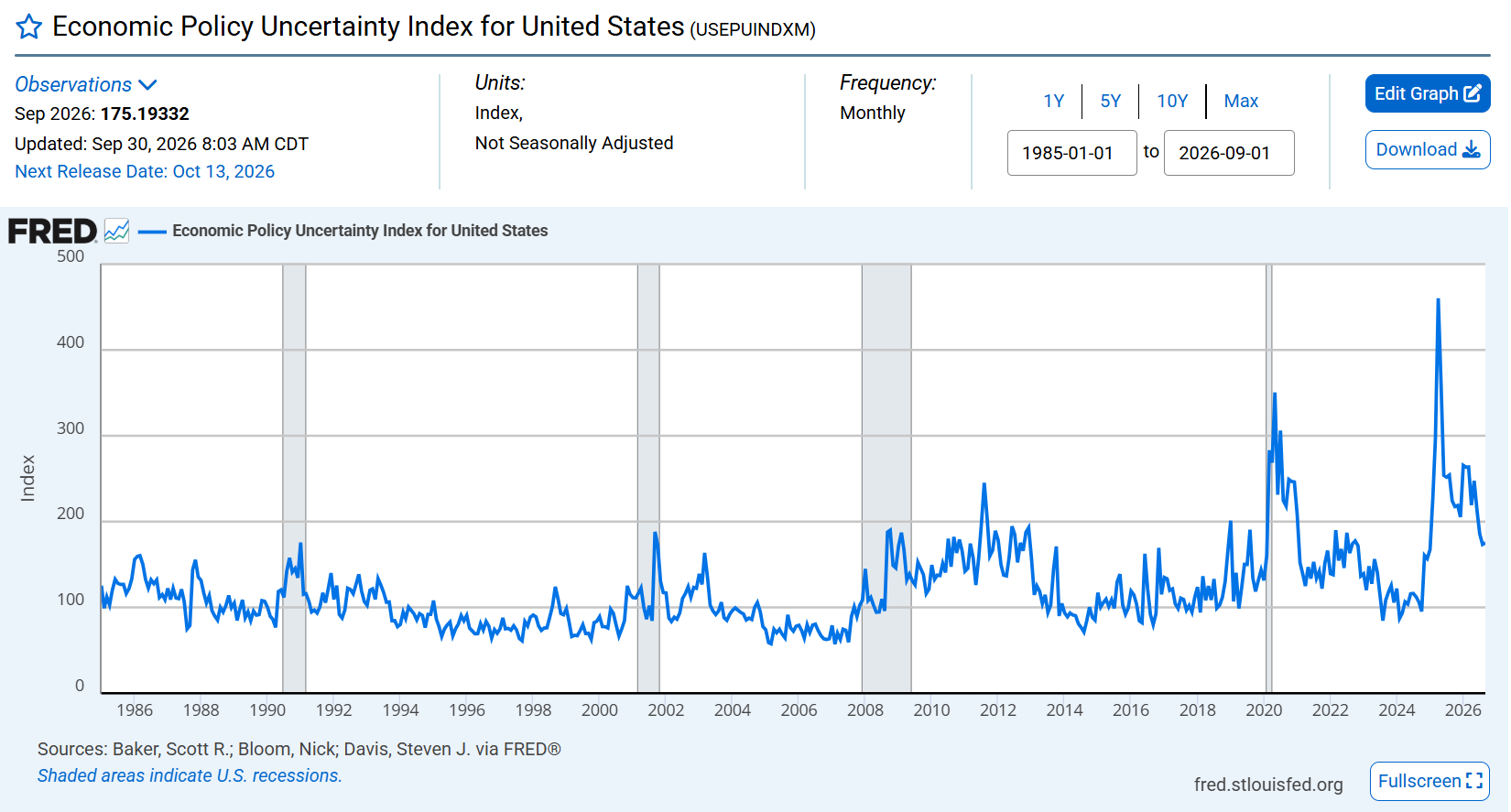
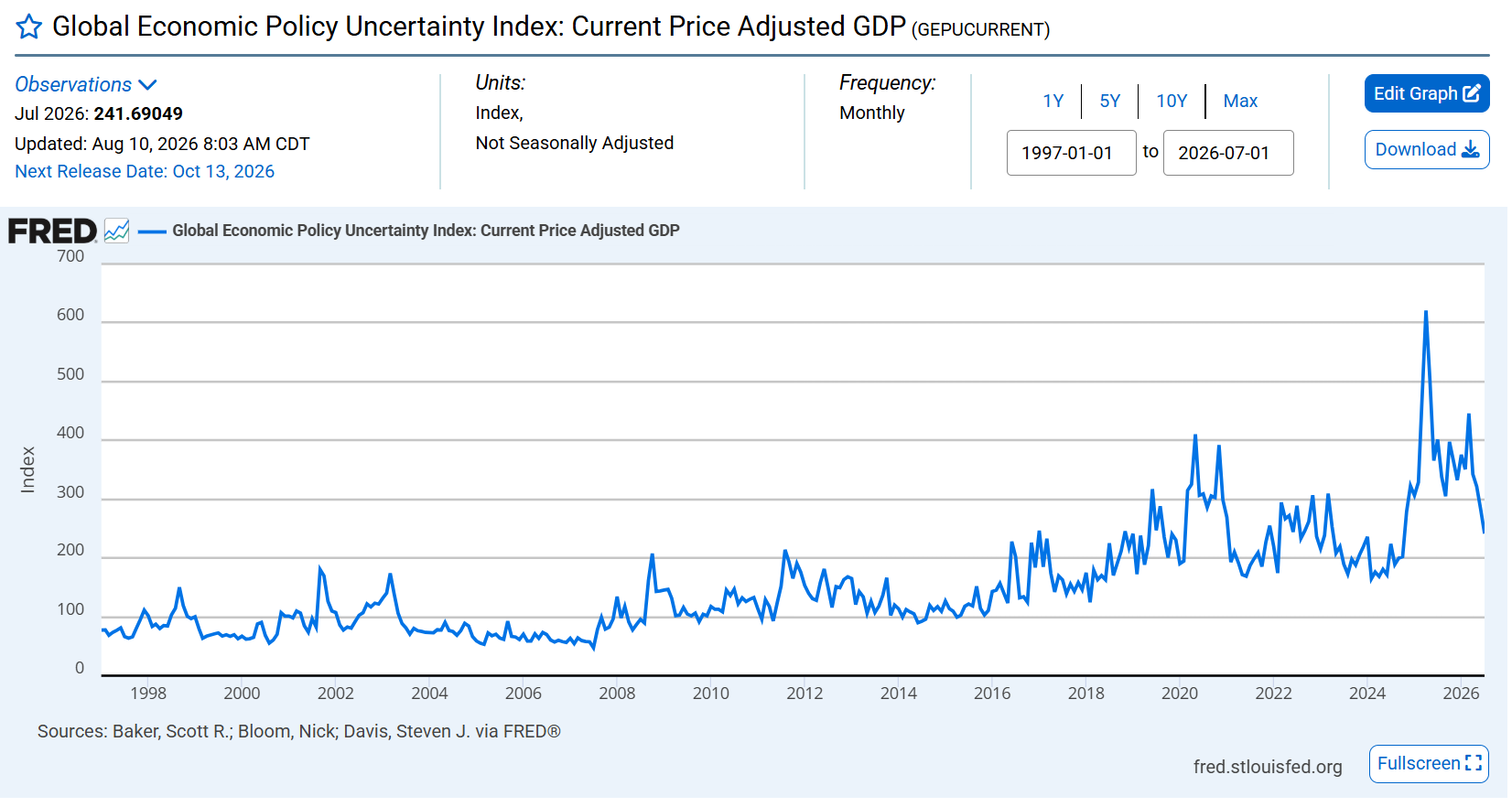
In spite of my enthusiasm for new tech, I am aware that stock market values are not necessarily connected to such innovations, especially in the short term. I am concerned that inflation and higher interest rates will be with us for a while, and political risks have increased. I have made some adjustments to client portfolios in response to these concerns.
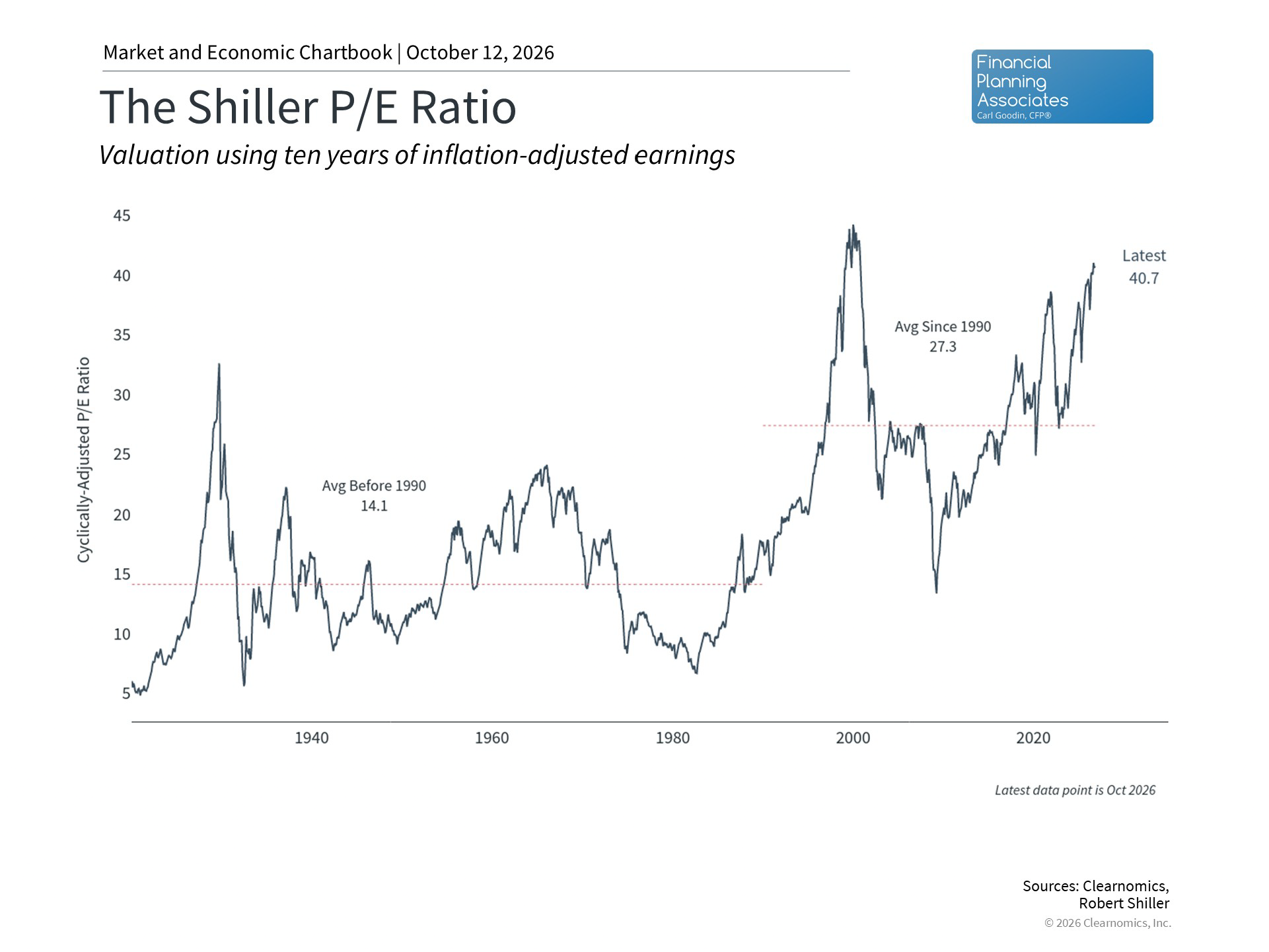
A high Shiller P/E Ratio can precede lower equity returns.
As a reward for paying attention to my blog, please enjoy an excellent performance of Sweet Love!
Sweet Love (Anita Baker) cover by Leonid & Friends
Thanks for reading.

Information including graphic images is drawn from sources we believe to be true and reliable including government publications, Morningstar Direct Advisory Suite, and Clearnomics, Inc. Our client investment reports are produced using the Black Diamond Wealth Management platform, in adherence to GIPS standards for reporting investment results. We provide a secure client portal for continuous access to asset values, returns, taxable gains and losses, and transactions, including investment management fees. In some cases, graphic images can be enlarged by simply clicking the image.