

That’s ridiculous…this is an economy that is driven by good economic policy, good monetary policy, and good trade policy, and it’s working beautifully!
On any given day, investors can likely find highly regarded financial advisors, analysts, professors, politicians, and media influencers offering opinions about the current state of the economy, interest rates, stock values, the future of cryptocurrencies, etc. It is quite common for those opinions to diverge, even when offered with conviction. For example, prior to the Great Recession of 2008, CNBC broadcast a discussion between Peter Schiff and Arthur Laffer. Peter warned of a coming recession as Arthur confidently asserted that, “That’s ridiculous…This is an economy that is driven by good economic policy, good monetary policy, and good trade policy, and it’s working beautifully!”
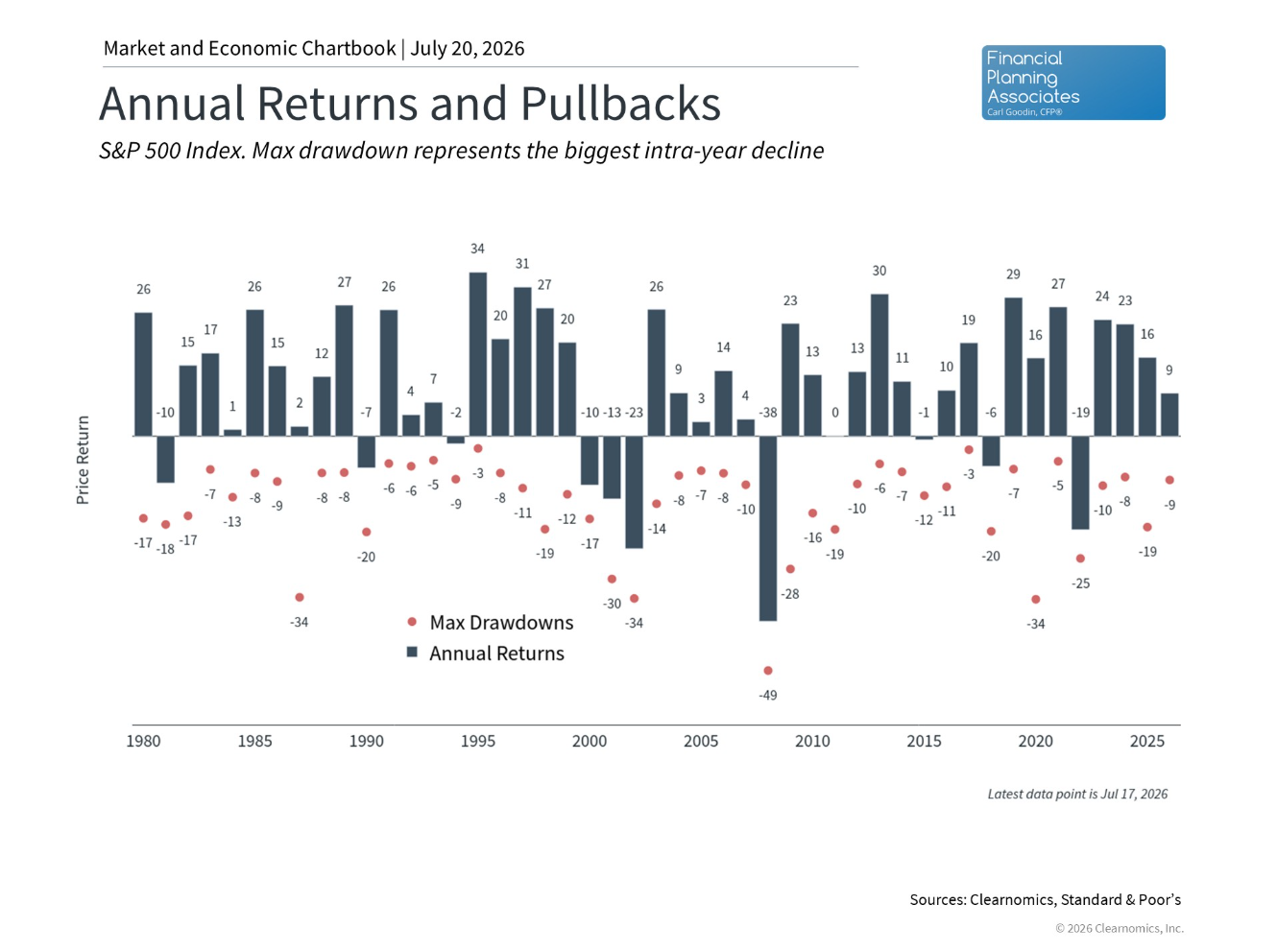
Officially, according to the National Bureau of Economic Research (NBER), the subsequent recession in the US began in December 2007 and lasted until June 2009. In 2008 the S&P 500 index lost 38% of its value. An investor holding this index for less than the full year could have suffered a loss of 49%. (Theoretically, an investor cannot buy an index, but today it is possible to hold a very good proxy of the S&P 500 for a very small cost.)
The good news.
Take a moment to consider how you have felt, or would feel, after having seen the value of your stocks drop by 38%. Do you think your next investment decisions would be the same as if your stocks had gained value? The good news is that despite recessions, corrections, and bear markets, stock markets usually gain value over the long term. Check out the image below, which shows S&P 500 annual price returns and pullbacks since 1980. As stated above, an investor holding this index for all of 2008 would have lost 38%, not considering the value of dividends paid, which would have reduced the loss to 37%. However, the annual returns for the following six years were +23%, +13%, +0%, +13%, +30%, and +11%, respectively. In most years, stocks gain value, and investors are likely to be rewarded if they hold stocks “for the long run”, but in the short run, investors can suffer significant losses. For example, as shown below, the returns during 2000, 2001, and 2002 were -10%, -13%, and -23%. Three consecutive years of increasing losses would, and did, cause some investors to “cash out” of the stock market.
The takeaway.
Humans do not like losing money. Losing money can cause otherwise intelligent, reasonable people to make decisions not conducive to maintaining and/or increasing wealth. So, what is the solution? I’m glad you asked. Having a coordinated, comprehensive financial plan that supports an appropriate investment risk management strategy can increase one’s confidence during good times and bad, which can contribute to increasing wealth and confidence.
FPAI investment management clients, your reports are continuously posted in your Black Diamond client portal. Using the best available information, the Black Diamond Wealth Management platform adheres to GIPS standards for reporting investment results. Asset values, returns, taxable gains and losses, and transactions, including investment management fees, are itemized under the Client Portal / Portfolio link.
Thanks for reading,
Carl