

Political parties and stock returns:
The United States political landscape is dominated by two parties. Is one party better than the other? Don’t answer that. It is a rhetorical question. Does one party create more wealth than the other? Again, a rhetorical question. If when you read the two previous rhetorical questions you mentally jumped to a conclusion you must first define “better” and “wealth.” A slightly more quantifiable question might be, does the US stock market do better under one party than the other? The graphic below summarizes some of the relevant information.
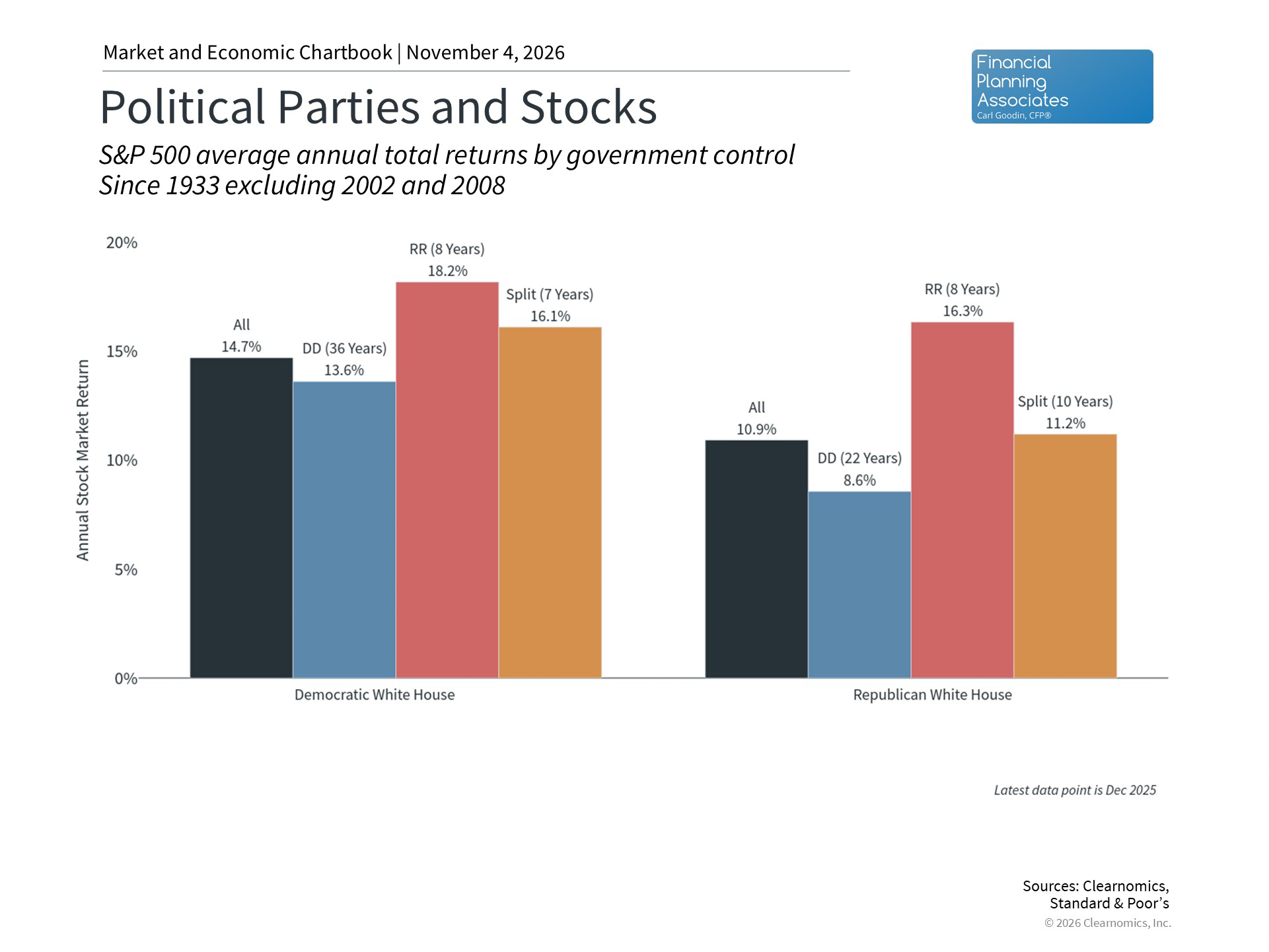
Note about methodology: The graphic above excludes data from 2002 and 2008, which were years of substantial market declines under Republican presidents. The logic provided by Clearnomics is that the reasons for the declining values had little to do with the president. Copilot identifies some reasons below for the declines.
2002: the aftermath of the dot-com collapse, recession, accounting scandals and related market weakness
2008: the global financial crisis, including the collapse of Lehman Brothers and fears of financial-system failure.
It has been said that presidents are given too much credit for good markets, and too much blame for bad ones. I agree. However, the traditional Republican opposition to governmental regulation of businesses and economies would seem to have contributed to these particular problems. No doubt, some of my friends will want to debate this point.
My summary: The above charts look nice. They convey some information. Historically, stock market returns, although positive, have been lower when a Republican president faces a Democratic congress, which will be our situation come January. As I write this, the morning following the mid-term elections, US stocks are up about 2%. The 10-year US Treasury note yield is still slightly below 5%. My guess is that US stock returns will be below average during the next couple of years. Although not the primary reason for my conclusion, the charts support it.
About peptides:
Lately, I’ve seen stories promoting the use of peptides to treat diabetes and/or obesity, increase muscle growth, and counter the effects of aging among other benefits. So, I consulted Microsoft Copilot to get a sense of what peptides are and what information might be trustworthy concerning the benefits. The text below is a brief summary of some of Copilot’s responses. If you have an interest in some of the potential benefits promoted from any news source, including AI apps, you should do further research and consult a healthcare professional. We live in a complex world, and a little knowledge can be dangerous.
From Copilot:
Peptides are short chains of amino acids, the same building blocks that make up proteins. A useful way to think of them is:
amino acids → peptides → proteins
Why peptides matter
The body naturally produces thousands of peptides. Many operate as chemical messengers, telling cells or organs what to do.
Examples include:
- Insulin, which regulates blood glucose
- Glucagon, which helps raise blood glucose
- Oxytocin, involved in several nervous-system and reproductive functions
- Vasopressin, important for water balance and blood pressure
This signaling ability is why peptides have become important medicines.
The “peptides” you may be hearing about lately
Today, “peptide therapy” is often used much more broadly, particularly by anti-aging, weight-loss and sports clinics. It can include substances such as:
- Semaglutide and tirzepatide-related drugs, which act on peptide hormone pathways and are used for diabetes and/or obesity.
- BPC-157, promoted online for healing and recovery.
- CJC-1295 and ipamorelin, promoted for increasing growth-hormone activity.
- Various peptides marketed for muscle growth, fat loss, sexual function, skin improvement or “anti-aging.”
There’s an important distinction: a peptide being biologically active doesn’t mean that a particular peptide treatment has been demonstrated to be safe and effective in humans. Some are well-established prescription medicines; others marketed by clinics or online have far weaker evidence and may not be FDA-approved for those uses.
About Roth conversions:
One benefit of our financial planning process is an analysis of Roth conversions. Our recommendation is that the conversions, when appropriate, be done in the last quarter of the year. If you intend to do a Roth conversion this year, now is the time. If you are not already on my calendar, please make an appointment soon.
Joke:
Driver picks up a hitchhiker.
Hitchhiker: Thank you for picking me up, but, how do you know I’m not a serial killer or something?
Driver: I don’t know for sure, but the chances of two serial killers being in one car would be astronomical.

Another joke:
Fred was a popular man, but sadly he passed away. His friends and widow gathered to remember him,
Fred’s best friend gets up and says to the widow, “May I just say a word?”
“Of course,” she says.
“Plethora,” he says and sits down.
“Thank you,” says the widow, “that means a lot.”
Thanks for reading.